
How to Source Packaging for a 3PL: Stock, Custom, and Client-Supplied Options

A 3PL should source packaging through a documented decision process: decide whether each job needs stock, client-supplied, custom, or hybrid packaging; issue one measurable specification; compare suppliers on the same scope; approve a physical sample; and control inventory, artwork versions, inspection, and release. The cheapest unit price is rarely the lowest-risk option when minimum order quantities, storage, obsolete print, dimensional errors, and replenishment delays are included.
Packaging looks like a consumable until a warehouse must support many clients, product shapes, carrier rules, and branding requirements at once. A carton that is slightly too large can increase dimensional weight. Weak board can create damage claims. An old artwork file can turn usable inventory into waste. A late replenishment can stop fulfillment even when the product is ready.
For 3PL operators, the sourcing decision therefore combines purchasing, operations, storage, quality control, and client ownership. The goal is not simply to find a box supplier. It is to create a repeatable packaging system that protects fulfillment speed and keeps responsibility clear.
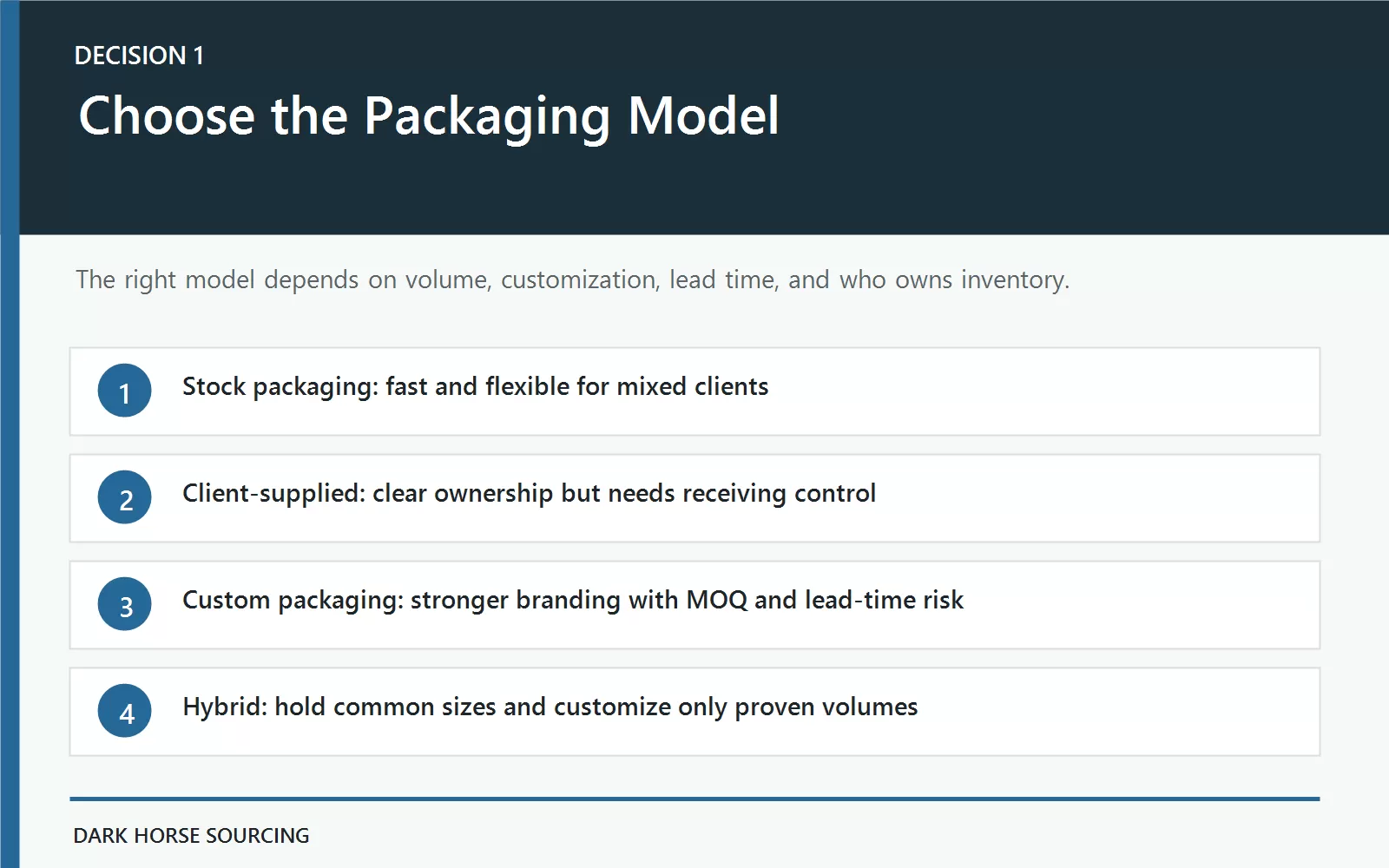
Stock packaging is usually the best starting point for common carton sizes, mailers, tape, void fill, and labels. It reduces lead time and lets a warehouse serve mixed demand without committing to client-specific inventory.
Client-supplied packaging can work when the client has an established vendor or strict brand control. The 3PL still needs receiving checks, storage rules, reorder alerts, and a written answer for shortages or damaged materials.
Custom packaging makes sense when volume is predictable and the commercial value of fit, protection, unboxing, or branding outweighs tooling, minimum order quantities, longer lead times, and inventory risk. A hybrid model is often strongest: stock packaging covers variable orders while proven products move to custom formats.
Before requesting prices, record the monthly usage range, peak demand, number of SKUs, required sizes, customization level, available storage, and acceptable replenishment time. This prevents a low quote from driving a model that does not fit warehouse reality.
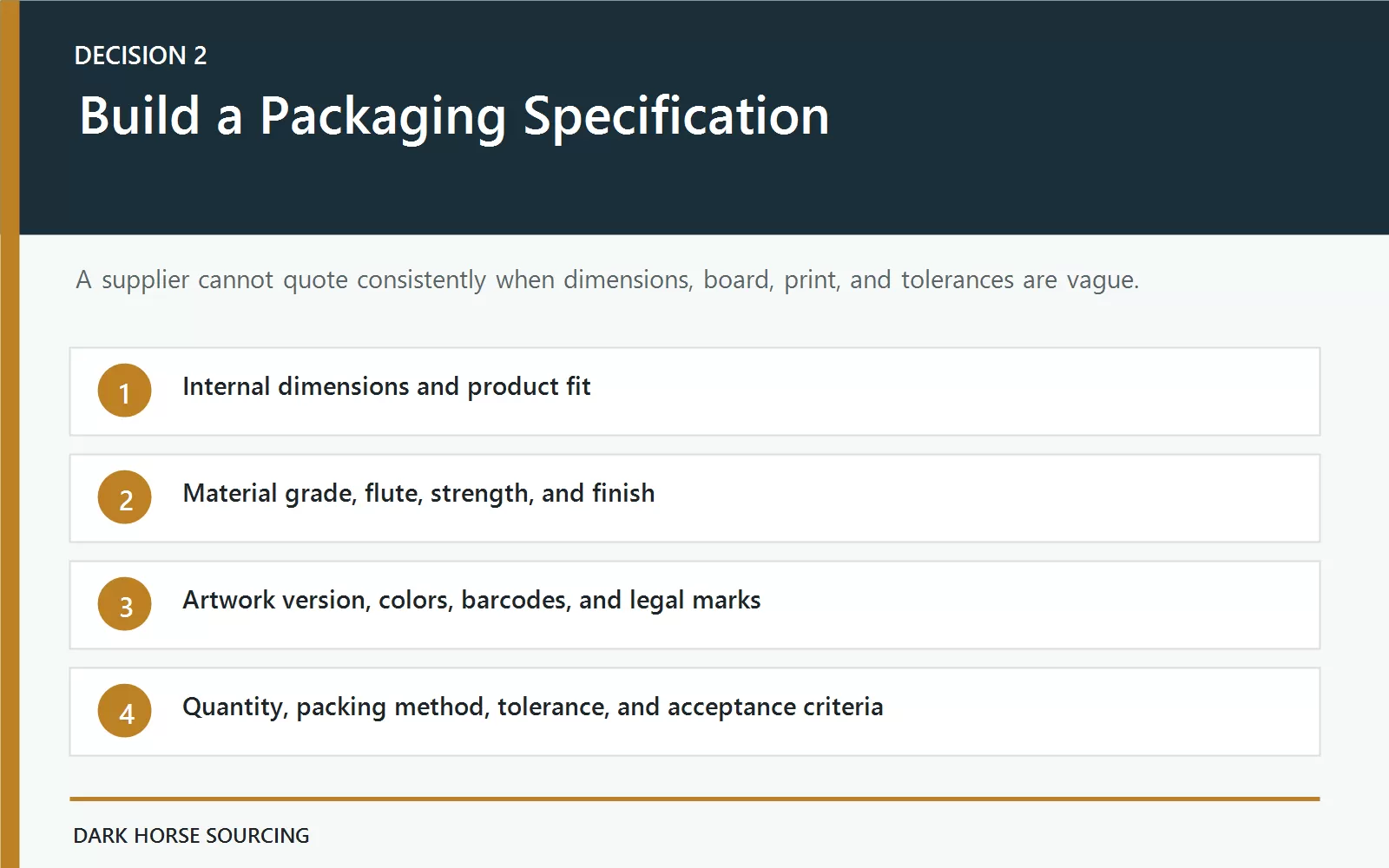
Suppliers cannot quote or produce consistently from a photo and a rough size. Build a specification that states:
Use internal dimensions when product fit matters and define how dimensions will be measured. For printed packaging, place a version number and approval date on the artwork file. Barcodes and compliance marks should be checked as functional data, not treated as decoration.
Ask shortlisted suppliers to quote the same specification and separate tooling, samples, unit price, printing, packing, inland freight, export terms, taxes, and optional services. Also record the minimum order quantity, production lead time, sample lead time, payment terms, defect remedy, and quotation validity.
A unit-price comparison misses the cost of unused packaging, warehouse space, repacking, rush freight, or fulfillment interruption. For imported packaging, include international freight, duty, customs handling, and the effect of bulky cartons on landed cost. Flat-packed formats can reduce freight and storage but may add warehouse assembly labor.
For a China supplier, verify the legal company, factory or trading role, payment beneficiary, production capability, and experience with the required material and print process. Do not rely on a marketplace badge or sales presentation alone.
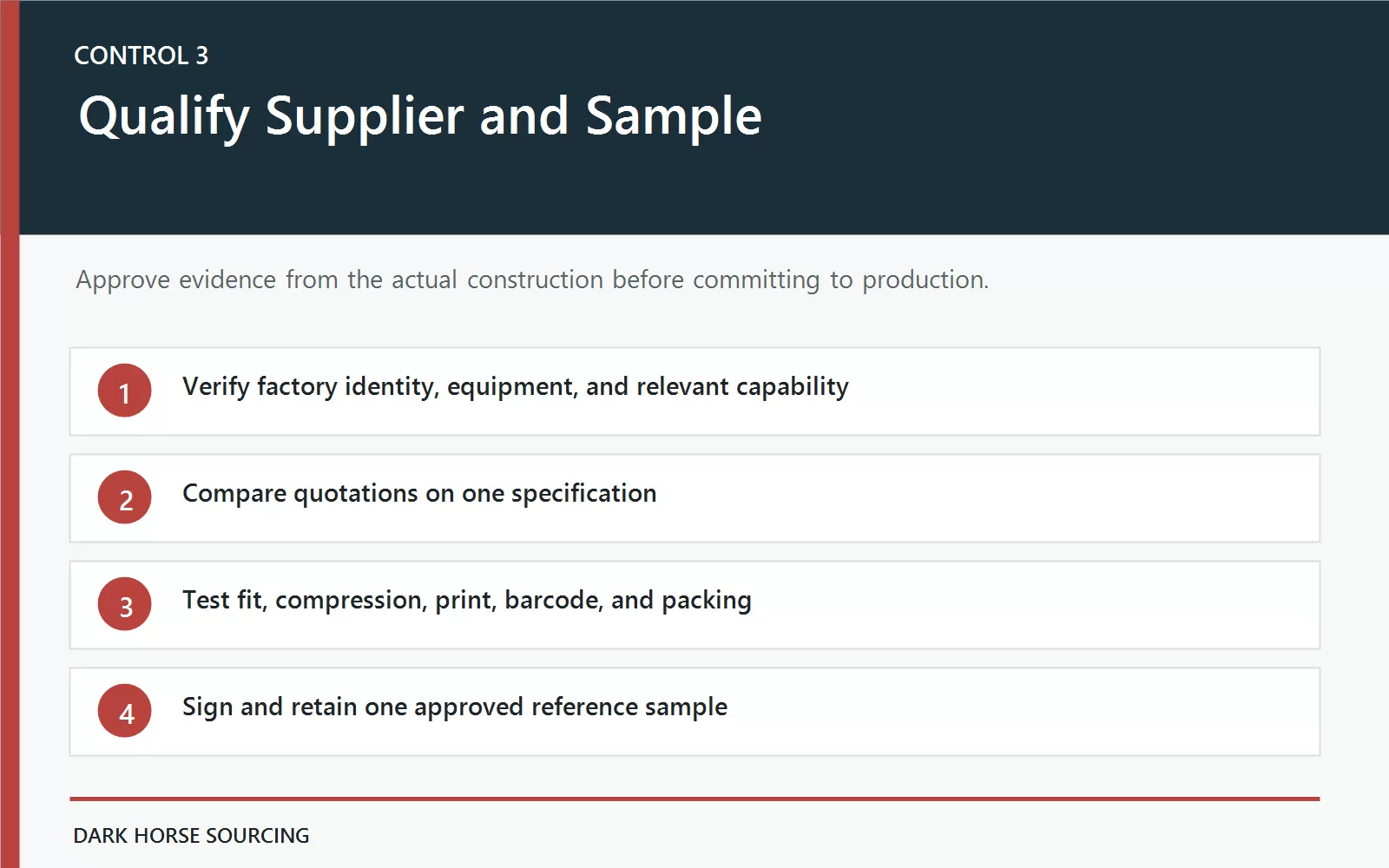
A digital proof confirms layout, not construction. Approve a physical sample from the intended material and process whenever fit, strength, print, finish, or assembly affects performance.
The sample review should cover:
1. product fit and protective clearance;
2. assembled dimensions and dimensional-weight effect;
3. material, seams, folds, glue, tape, and closure;
4. compression or transit tests appropriate to the job;
5. artwork position, color, legibility, and barcode scanning;
6. packing efficiency and warehouse handling time.
Sign and retain one reference sample or a complete approved sample record. Production inspection should compare against this reference. If the supplier changes material, tooling, print method, subcontractor, or manufacturing location, require reapproval before shipment.
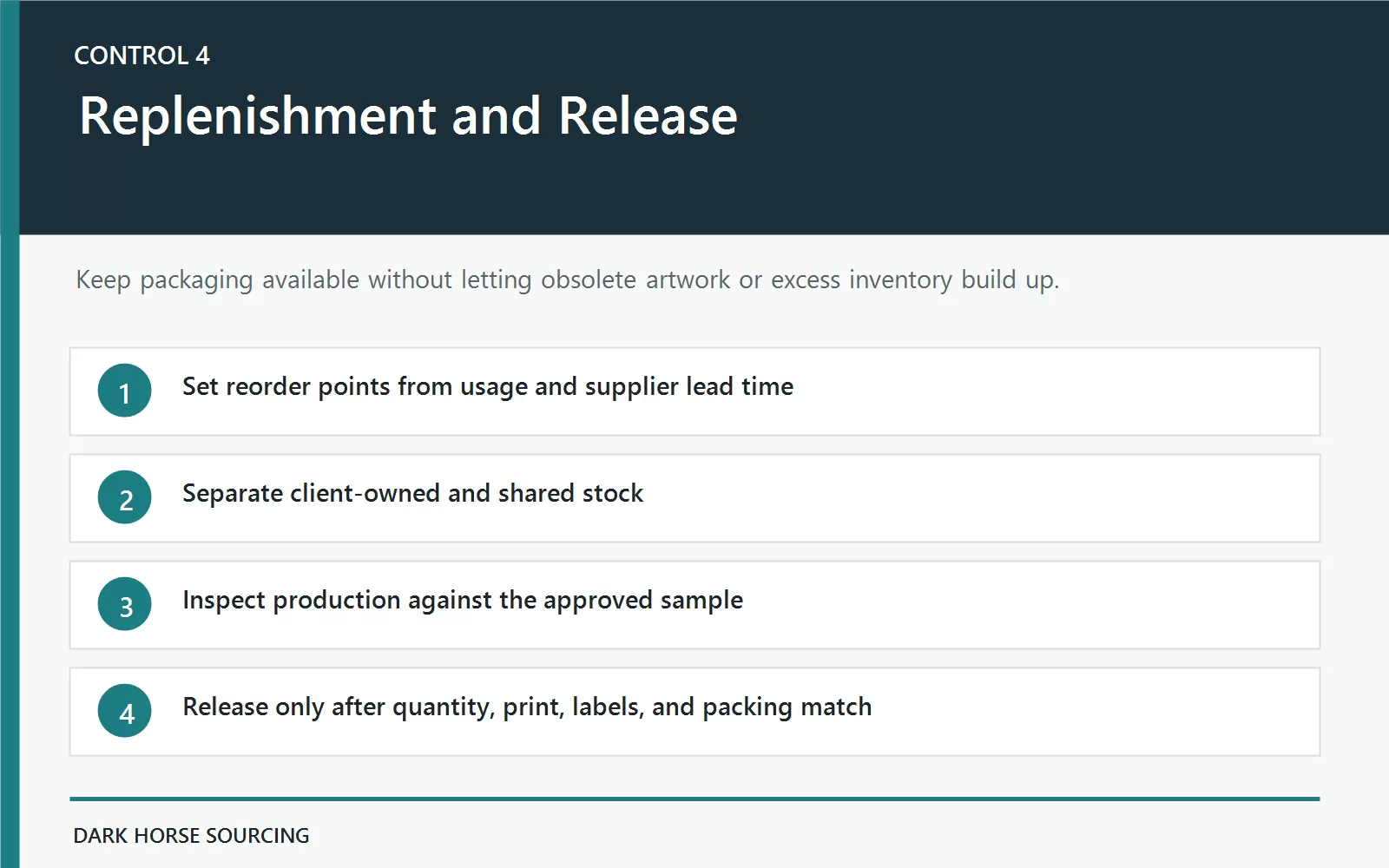
Packaging inventory should have an owner, reorder point, and obsolescence rule. Separate shared warehouse materials from client-owned stock in both the physical location and inventory system. Track receipts, usage, adjustments, damage, and remaining quantity by item and artwork version.
Set reorder points from actual usage, supplier lead time, freight time, inspection time, and a reasonable variability buffer. Do not use a generic safety-stock percentage for every item. A plain stock carton and a printed seasonal insert have different risk.
For custom packaging, agree who pays for excess inventory, obsolete artwork, discontinued products, and storage beyond the planned period. These decisions should be in the client agreement before stock accumulates.
Before a custom packaging order leaves the supplier, reconcile the purchase order, approved sample, artwork revision, quantity, dimensions, materials, print, labels, and packing. Use photos and measurement records tied to the actual production lot.
Place the shipment on hold when barcodes fail, print uses the wrong version, dimensions exceed tolerance, cartons are weak or wet, quantities differ, or packing will cause freight or warehouse problems. Schedule pressure does not make a nonconforming shipment acceptable.
Dark Horse Sourcing can support overseas 3PLs, importers, distributors, and ecommerce operators with China-side packaging supplier identification, factory verification, quotation normalization, sampling coordination, production follow-up, quality inspection coordination, carton and artwork checks, consolidation, and shipment-release evidence. The objective is to keep supplier selection, the approved sample, production, and logistics connected through one auditable process.
Local supply is often better for low-volume, urgent, or highly variable stock packaging. China sourcing can be suitable for stable custom volumes where tooling, print, and unit economics justify the longer lead time and landed-cost controls. Compare the complete operating model, not only unit price.
Clients may provide packaging when they need strict brand control or have an existing supply contract. The client and 3PL should still define receiving inspection, storage, reorder alerts, shortage handling, ownership, and obsolescence.
Give each supplier the same measurable specification. Compare company identity, manufacturing capability, sample quality, tooling, unit price, minimum order quantity, lead time, tolerance, packing, freight, payment terms, and remedy for defects.
Check fit, dimensions, material, strength, assembly, print, finish, barcode readability, packing efficiency, and any relevant carrier or marketplace requirement. Keep the approved sample as the production reference.
Use version-controlled artwork, conservative initial quantities, item-level usage tracking, clear ownership terms, reorder points based on actual demand, and written rules for product or branding changes.
For a packaging project with stable volume and China sourcing potential, request a China Sourcing Risk Assessment covering supplier identity, specification, sample, production, and shipment controls.
Contact us
Call Us: +86 193 7668 8822
Email:info@darkhorsesourcing.com
Add: Building B, No.2, He Er Er Road, Dawangshan Community, Shajing Street, Bao'an District, Shenzhen, China
 @Darkhorsesroucing


 EN
EN
 ar
ar
 da
da
 nl
nl
 fr
fr
 hu
hu
 it
it
 pl
pl
 pt
pt
 es
es
 sv
sv
 de
de
 cs
cs
 ga
ga
 ro
ro
 sk
sk
 tr
tr
 hi
hi
 ru
ru
 bn
bn