
Asian Size to US Size Chart: The Complete Guide for Clothing Importers (2026)

Key Takeaways
The Difference: Asian sizes are typically 2 to 3 sizes smaller than US/EU standards due to different body types and fit preferences.
The Risk: Relying on "Standard" charts leads to high return rates. Always request a Physical Size Spec from the factory.
Pro Tip: Dark Horse Sourcing provides On-Site Garment Measurement to ensure your bulk production matches your tech pack perfectly.
Introduction
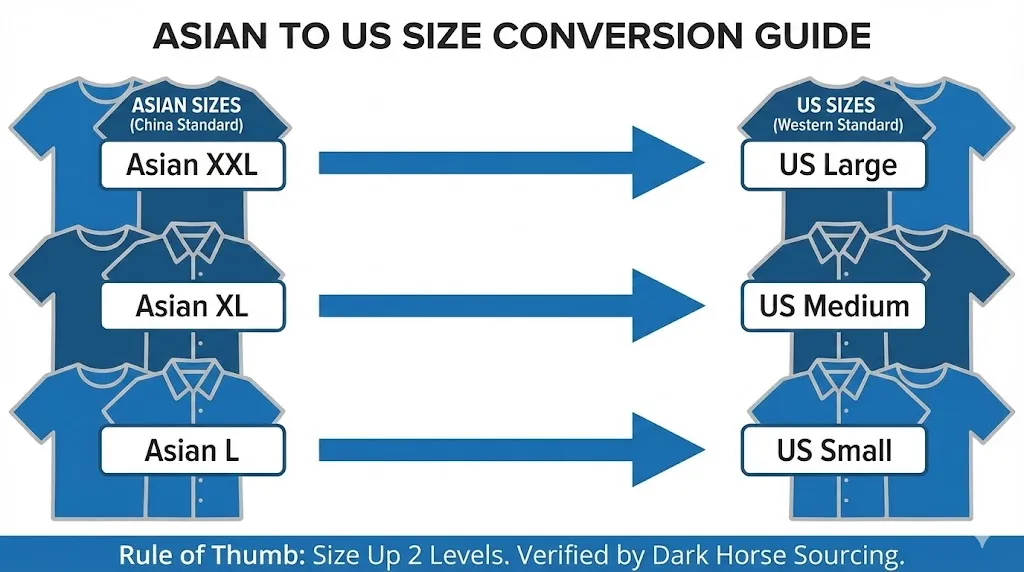
If you are sourcing apparel from 1688.com or Alibaba, you’ve likely seen the warning: "Our sizes are Asian sizes, please choose 2 sizes larger."
For an individual shopper, this is an inconvenience. For a clothing importer ordering 2,000 units, this is a financial disaster waiting to happen. Sizing inconsistency is the #1 reason for negative reviews and high return rates on platforms like Amazon and Shopify.
In this guide, we provide the most accurate Asian size to US size conversion charts for 2026 and reveal the professional "insider" steps to ensure your garments fit your customers perfectly every time.
Asian men's clothing is designed with a slimmer profile, narrower shoulders, and shorter sleeve lengths compared to US "Regular" or "Relaxed" fits.
|
Asian Size |
US Equivalent |
Chest (Inches) |
Chest (CM) |
|
L |
Small |
36" - 38" |
91 - 96 |
|
XL |
Medium |
39" - 41" |
99 - 104 |
|
2XL |
Large |
42" - 44" |
107 - 112 |
|
3XL |
X-Large |
45" - 47" |
114 - 119 |
|
4XL |
2X-Large |
48" - 50" |
122 - 127 |
Note: For "Oversized" or "Streetwear" fits, the conversion may differ. Always verify the Flat Lay measurements.
Women’s sizing in China is based on a "Petite" frame. The hip-to-waist ratio in Asian patterns is often too narrow for the US market. An Asian "Large" is often equivalent to a US "Small."
|
Asian Size |
US Numeric |
US Alpha |
Waist (Inches) |
Waist (CM) |
|
M |
0 - 2 |
XX-Small |
24" - 25" |
61 - 64 |
|
L |
4 - 6 |
Small |
26" - 27" |
66 - 69 |
|
XL |
8 - 10 |
Medium |
28" - 30" |
71 - 76 |
|
2XL |
12 - 14 |
Large |
31" - 33" |
79 - 84 |
|
3XL |
16 - 18 |
X-Large |
34" - 36" |
86 - 91 |
"Charts are just for reference. In China, every factory uses its own pattern paper. A 'Large' in a Guangzhou factory might be a 'Medium' in a Ningbo factory. This is why Dark Horse Sourcing always insists on a Physical Tech Pack.
We don't just 'hope' the size is right; our inspectors go to the factory with a measuring tape and check the actual garment dimensions against your US brand's requirements."
Understanding why the gap exists helps you communicate better with your manufacturers.
1. Body Morphology: Asian patterns are built for a narrower bone structure. Even if the chest measurement seems correct, the armholes and hip circumference are often too tight for the average US consumer.
2. The "Slim Fit" Trend: Most 1688 and Alibaba factories produce for the domestic Chinese market, where a "tight" or "slim" fit is preferred.
3. Fabric Shrinkage: Low-cost manufacturers often don't account for shrinkage in their size charts. After one wash, a borderline "Medium" can become a "Small."
Mistake 1: Trusting the Factory’s PDF Chart
Most factories copy-paste generic charts. They don't actually measure the final garment after it's been sewn and pressed.
Mistake 2: Ignoring the "Manual Measurement" Error
In China, a common term is "误差" (Error Range). Most factories claim a 2-3cm error is "normal." For a US "Small," a 3cm error makes it a "Petite."
Mistake 3: Skipping the Pre-Shipment Measurement
If you ship 5,000 units to an Amazon Fulfillment Center and the sizes are wrong, it is too late. The cost of a "Removal Order" and shipping back to China will bankrupt the project.
We don't just find you a factory; we act as your Quality Control Firewall.
When you source apparel through Dark Horse Sourcing, we implement a 3-step sizing verification process:
1. Tech Pack Verification: We review your US size specifications and ensure the factory creates a unique pattern for the Western market—not just "upsizing" their existing Asian pattern.
2. Gold Sample Measurement: Before mass production starts, we measure the "Gold Sample" in our lab to verify the Chest, Length, Sleeve, and Hips.
3. On-Site AQL Inspection: During production, our inspectors go to the factory. We randomly select units and measure them against the approved spec sheet. If we find a 5% deviation, we stop the line.
Don't let an Asian size to US size chart be the reason your brand fails. While charts are a good starting point, they are no substitute for professional, on-site measurement and factory auditing.
Are you planning a clothing line in China?
Stop guessing the sizes. [Contact Dark Horse Sourcing Today] for a professional garment inspection quote and let our engineers ensure your fit is perfect.
Q: Is an Asian XL a US Large?
A: Usually, no. An Asian XL is typically equivalent to a US Medium. In many cases, you need to go up two full sizes to match Western standards.
Q: What is the best way to ensure correct sizing when buying from Alibaba.com?
A: Always provide a Physical Size Spec (Tech Pack) in centimeters and inches. Do not rely on "S/M/L" labels. Hire a sourcing agent to measure the goods at the factory before shipping.
Q: Do Chinese factories follow US standard sizing?
A: Only if they are experienced exporters. Factories that focus on the domestic market will always use Asian sizing patterns unless specifically told otherwise.
Contact us
Call Us: +86 193 7668 8822
Email:[email protected]
Add: Building B, No.2, He Er Er Road, Dawangshan Community, Shajing Street, Bao'an District, Shenzhen, China
 @Darkhorsesroucing


 EN
EN
 ar
ar
 da
da
 nl
nl
 fr
fr
 hu
hu
 it
it
 pl
pl
 pt
pt
 es
es
 sv
sv
 de
de
 cs
cs
 ga
ga
 ro
ro
 sk
sk
 tr
tr
 hi
hi
 ru
ru
 bn
bn