
From Idea to Amazon FBA Launch: Realistic China Sourcing Timeline for Private Label in 2026

Why does it take so long? China’s supply chain is stable, but it involves multiple layers: design iterations, compliance testing, logistics, and customs clearance. In 2026, customs inspections are stricter and compliance requirements are higher. This guide uses the latest data and real-world experience to break down every stage month by month, helping Amazon FBA sellers create solid plans, compress timelines, and avoid expensive mistakes.
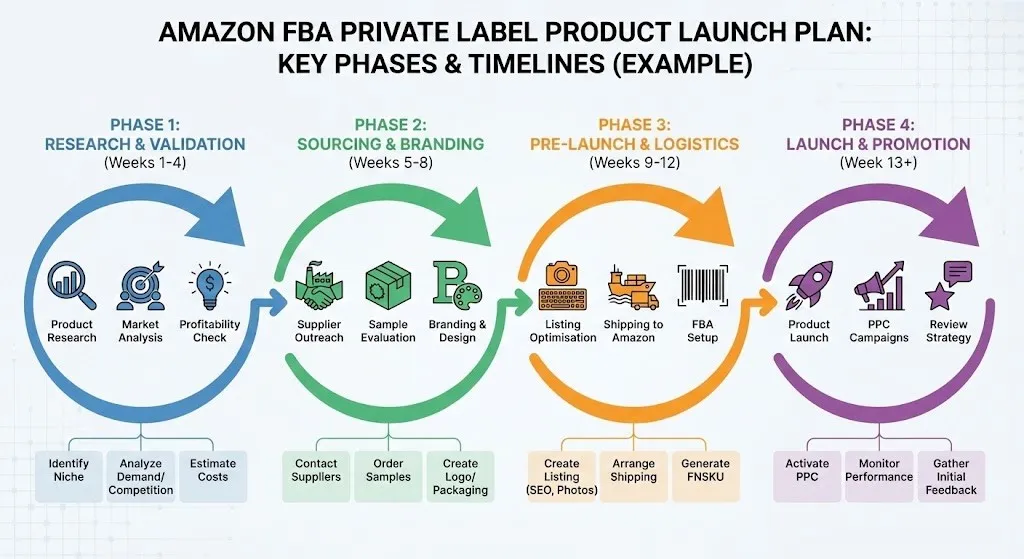
(Above: Example of an Amazon FBA private label product launch plan infographic showing key phases and timelines)
Here’s the standard timeline for a medium-complexity product (e.g., kitchen gadgets, beauty tools, or home essentials). Simple categories (apparel/home goods) can compress to 4–6 months; complex ones (electronics/smart devices) often stretch to 6–10 months.
| Stage | Typical Duration | Cumulative Months | Key Deliverables | Amazon FBA Impact | Main Risks |
|---|---|---|---|---|---|
| 1. Idea & Market Validation | 1–2 months | Months 1–2 | Product feasibility report + target pricing | Missing seasonal windows | Over-research delaying start |
| 2. Design & Tech Pack + Supplier Sourcing | 1–2 months | Months 2–3 | Complete Tech Pack + supplier shortlist | Listing keyword foundation | Vague specs causing later changes |
| 3. Sampling & Iteration | 2–3 months | Months 3–5 | Golden Sample approved | Real product photos/A+ content | Excessive revisions |
| 4. Tooling, Compliance & Pre-Production | 1–2 months | Months 5–6 | Molds OK + compliance certificates | Packaging/label compliance | Test failures requiring redo |
| 5. Deposit → Production → QC → Shipping | 2–3 months | Months 6–8/9 | Finished goods at FBA | Warehouse check-in + live listing | Quality fade / logistics delays |
| 6. FBA Arrival & Launch Prep | 1–2 months (overlapping) | Months 8–9+ | Listing live + initial sales | Stockout fees / overstock | Inbound label errors |
Category Differences: Apparel/home goods: 4–6 months; Electronics/beauty: 6–9 months (extra FCC/CE/FDA testing).
Everything starts here. Many sellers skip this and jump straight to factories, only to redesign everything later.
Key Steps:
2026 Trend: AI tools (ChatGPT plugins or specialized product research software) speed up niche selection and filtering low-competition ideas.
Pitfall to Avoid: Don’t chase viral trends blindly—over-research delays launch; rushing leads to later pivots.
The core is turning your idea into a factory-understandable blueprint.
Key Steps:
Pitfall to Avoid: Vague specs cause major sample deviations and repeated returns. In 2026, use AI factory matching to prioritize suppliers with existing similar molds for faster starts.
This stage causes 80% of delays. Typical 3-round process:
Acceleration Tips: Use video/high-res photos for remote approval instead of physical returns; lock design early to minimize changes.
For more development details, see our full article: China Product Development Timeline.
Related Guide: For electronics AQL inspection standards, see AQL 2.5 Quality Inspection Guide for Electronics.
After paying the 30% deposit, enter execution phase (typically 2–3 months).
Simplified Flow:
Key Rule: Pay the balance only after QC passes—this is your final leverage.
For deeper details on the post-deposit “black box” period, daily risks (e.g., material delays, sudden price hikes, inspection refusals), and red flags, read our in-depth guide: What Happens After You Pay the Deposit to a Chinese Factory?
Shipping Options: Air is fast but expensive; Sea is economical but slow; DDP (Delivered Duty Paid) is recommended for beginners to avoid self-clearance hassles.
After goods arrive at FBA, there’s still 1–3 weeks of final steps:
Even after arrival, sellers lose time here.Common issues:
Incorrect FNSKU placement
Carton label mismatches
Random warehouse inspection delays
Inventory tip: 1,000–3,000 units is usually enough for launch without overexposing cash.
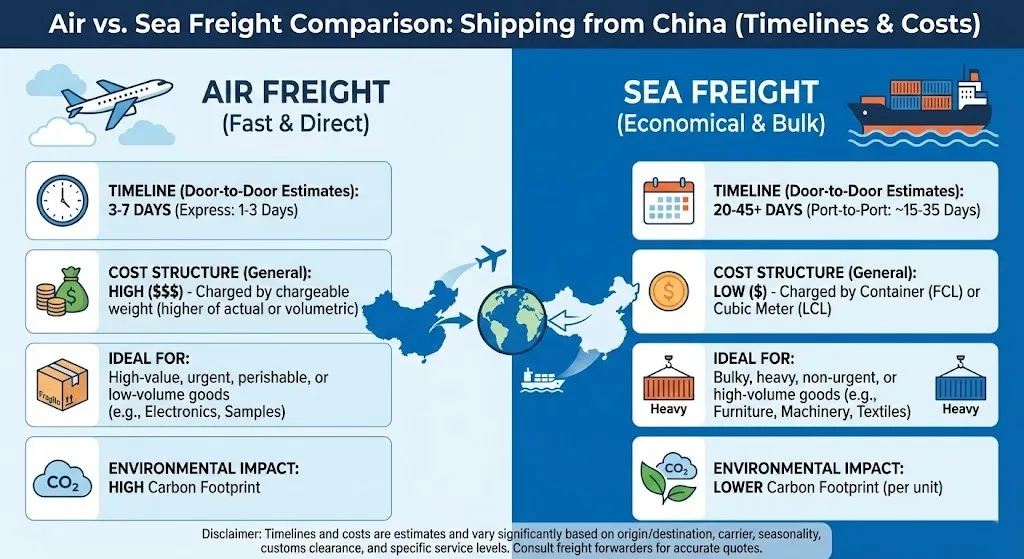
(Above: Air vs Sea freight comparison infographic for shipping from China, highlighting timelines and costs)
Want to compress 8 months down to 5–6? Try these:
Real Case: One client used AI matching + full oversight to shrink a kitchen product launch from 7 months to 5, hitting Q4 peak season perfectly.
Yes—by 20–40%, if you remove rework.
| Area | Typical Seller | Optimized Execution |
| Sampling | 60–90 days | 30–45 days |
| Compliance | 30 days | 10–15 days |
| Supplier Matching | 3–4 weeks | 7–10 days |
Is a 3‑month launch ever realistic?Only for extremely simple products using existing molds—and even then, it’s risky.
When should I start for a Q4 launch?At least 6–9 months earlier.
Timeline planning equals cash flow and profit protection. Don’t let “3-month launch” myths derail your Amazon journey. Map out each stage properly to burn less money and earn more.
Need a free 2026 timeline estimate for your product? Or AI-matched factories? Submit your idea here—Dark Horse Sourcing team responds within 24 hours – Empowering Amazon sellers with end-to-end China-to-FBA solutions.
Contact us
Call Us: +86 193 7668 8822
Email:[email protected]
Add: Building B, No.2, He Er Er Road, Dawangshan Community, Shajing Street, Bao'an District, Shenzhen, China
 @Darkhorsesroucing


 EN
EN
 ar
ar
 da
da
 nl
nl
 fr
fr
 hu
hu
 it
it
 pl
pl
 pt
pt
 es
es
 sv
sv
 de
de
 cs
cs
 ga
ga
 ro
ro
 sk
sk
 tr
tr
 hi
hi
 ru
ru
 bn
bn